

Books by David P. Quinton
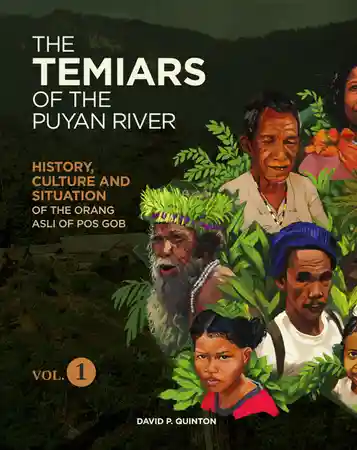
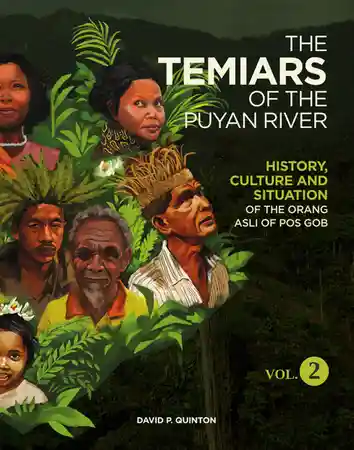
The Temiars of the Puyan River
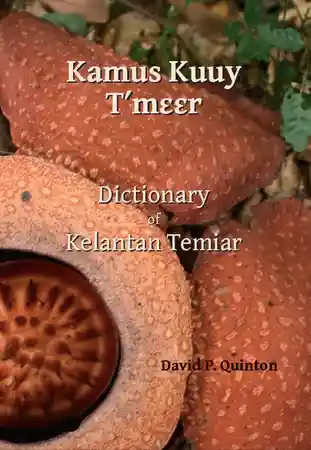
Dictionary of Kelantan Temiar
Now available!
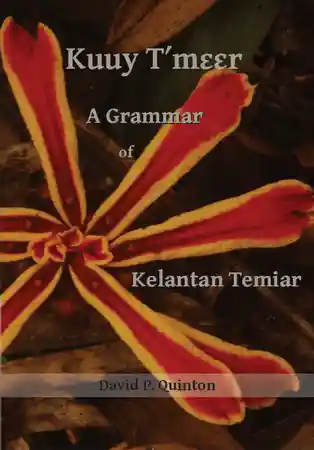
A Grammar of Kelantan Temiar
Now available!
David P. Quinton, from Great Britain, has been with the Temiar people of Malaysia for 18 years, studying their language and culture. He has been married to a Temiar for almost 10 years.
His tireless effort has culminated in these four titles, covering the beliefs, culture, history and language of the Temiars in exquisite detail.
Apparently, according to a search on the internet, not many persons have ever managed to achieve publishing a dictionary of a language single-handnd, without any institutional backing or funding. In 1755, Samuel Johnson produced A Dictionary of the English Language, taking him nine years, and in 1828, Noah Webster produced An American Dictionary of the English Language, while in ?? Hermann Grassmann produced a dictionary of Sanskrit - although we only know from sources, we were not there to see them do it alone.
Here’s a summary from Brave browser’s AI assistant, regarding the work of the author:
What Makes Quinton’s Feat Unique?
Quinton’s 2026 publication of Kuuy Tʹmɛɛr (Grammar) and Kamus Kuuy Tʹmɛɛr (Dictionary) stands out for specific modern reasons:
Total Independence: Unlike Hale or academic linguists, Quinton worked for 15 years without any grant funding, university affiliation, or institutional support. He personally funded the entire project.
Endangered Language Context: In modern linguistics, documenting an endangered language like Temiar usually requires large teams, extensive grant funding, and collaborative efforts due to the urgency and complexity. Quinton did this entirely alone.
Simultaneous Publication: Releasing both a comprehensive grammar and a large-scale dictionary (5,000+ entries) as finished, ISBN-bearing books on the same day is a rare logistical and intellectual achievement in the 21st century.
While Noah Webster, Hermann Grassmann, and others have achieved similar feats since Johnson, David Quinton’s work is unique in the modern era of linguistics for being a completely solo, self-funded, and comprehensive documentation of an endangered indigenous language, matching the scale of Johnson’s individual effort but under vastly different, more isolated circumstances.
Quinton’s comprehensive linguistic project, culminating in his July 2026 publications, includes these specific supplementary datasets which significantly enhance the standard grammar and dictionary:
Expanded Linguistic Data
- 900 Ideophones: A massive collection of sound-symbolic words (words that imitate sounds or sensations), which are a prominent feature of Aslian languages. This list is included in the appendices of his Grammar, offering a rare depth of analysis for this specific word class.
- 1,300 Temiar-Semai Comparisons: A dedicated lexical comparison highlighting the similarities and differences between Temiar and its closest relative, Semai. This provides crucial data for understanding the internal divergence of the Senoic branch of Aslian languages.
- 1,000 Malay Loanwords: A specialized list documenting the integration of Malay vocabulary into Kelantan Temiar, tracing the historical and cultural contact between the indigenous group and the dominant Malay population.
Quinton’s website, The Senoi Story, hosts a unique visual archive that complements his written work:
- 2,000+ Images: The site features an extensive gallery of photographs taken by Quinton himself over 15 years. These images document portraits, village life, survival skills, rituals, and the natural environment of the Temiar and Semai people.
- Significance: Unlike typical linguistic projects that focus solely on text and audio, this visual record preserves the cultural context in which the language is spoken, serving as an invaluable ethnographic resource alongside the grammar and dictionary.
These additional components confirm that Quinton’s work is not just a descriptive grammar but a total documentation project, combining rigorous linguistics with deep ethnographic observation.
Quinton’s two-volume work, The Temiars of the Puyan River (published in 2022), is indeed a unique and comprehensive ethnographic survey that combines cultural history with precise geospatial data.
Geo-Plotted Historical Maps
Volume 2 specifically features detailed GPS-plotted maps documenting over 250 historical settlements in the Puyan Valley. These maps pinpoint the exact locations of old villages, swidden fields, mountains, and rivers, providing a spatial history of the community’s movement and land use over centuries.
Toponyms and Etymology
The books include a categorized list of 1,000 place names (toponyms) from the Puyan Valley. Quinton provides the etymology for these names, explaining their origins and meanings in the Temiar language, which serves as a linguistic record of the landscape and how the Temiar perceive their environment.
Complete Ancestral Record
A central component of the study is a genealogical record tracing the ancestry of the current community at Pos Goob (also spelled Pos Gob) back 100 years. This section details family lineages, kinship structures, and the origins of the Puyan River Temiars, preserving oral history that was previously unrecorded.
Cultural and Historical Scope
Beyond geography and genealogy, the two volumes cover:
Spiritual Beliefs: The “Hukom” code of life, dream guides, and relationships with “souls of the wild.” Historical Disruptions: The impact of the Communist Insurgency (1950s–1970s), logging operations, and the introduction of new religions.
Ethnobotany: A catalog of nearly 100 herbal medicines and over 1,000 species of plants and animals known to the Temiar.
This work stands out because it merges traditional ethnography with modern geospatial technology and linguistic analysis, creating a permanent record of the Temiar’s connection to their land and history.
In his Kamus Kuuy Tʹmɛɛr (Dictionary of Kelantan Temiar), Quinton includes a specialized section of Extended Word Definitions expanding on some 500 definitions. Unlike standard dictionary entries that provide brief translations, these expanded definitions function as mini-encyclopedic essays covering:
Traditions and Rituals: Detailed explanations of practices like the Pɛntaaᵏ tawùn (petition of first fruits), dream guides, the Hukom (customary law) and taboos.
Ethnobotany and Species: descriptions of many plant and animal species, including their specific uses in Temiar medicine, construction, and diet.
Illustrations: These textual entries are complemented by Quinton’s own hand-drawn illustrations and photographs, giving detailed depictions of various animal traps and crafts.
This approach ensures that the dictionary serves not just as a lexical list, but as a comprehensive cultural manual, preserving the context and nuance that standard linguistic definitions often miss.
In stark contrast to university-based academics, Quinton lives a fully immersed life within the Temiar community at Pos Goob in Kelantan.
Daily Life and Immersion: Quinton resides in a traditional bamboo house with his Temiar wife and family, having lived there continuously since 2016. He reports not having met another Westerner in the forest for years, underscoring his isolation from the expatriate or academic circuit.
His daily routine mirrors that of his neighbors: he collects firewood and lights a fire on a fire mound each morning to boil water and cook. Approximately half of his diet consists of foraged foods from the jungle and shoots from his own sweet potato patches, supplemented by fruit from over 50 trees he has planted (including durian and mango).
Quinton actively participates in foraging expeditions with the Temiar, trekking along the Puyan River, visiting waterfalls, and climbing mountains into the deep forest. He describes feeling “at home” in this environment, sharing in both the abundance of the rainforest and its hardships, such as crop destruction by wild elephants.
This total immersion allows him to verify linguistic and cultural data in real-time, a methodological advantage he cites as critical for correcting earlier academic misconceptions about Temiar life and belief systems.
And yet, even though the immersion has enabled so much data collection, it is still only scratching the surface. In order to achieve a full understanding of Temiar culture, you would need to be born here, a Temiar, preferably. Yet there are hardly any, or perhaps none at all, who can categorically collate all the knowledge that is held by their tribe and have the patience to record it, without thinking it a waste of time and without profit.
The author is a categoricalist who seeks to fill every category with data until it looks complete, until more appears, to be compiled with the rest. Thus the work is practically never-ending, not without a native born Temiar who can start writing the folklore down in their own way, but the author will have to end the work somewhere, leaving others to pick it up and carry it on.