

The geodemographics of the Sen’oi peoples saw a massive shift during the last century, as they were pushed out from remote forest homestead locations into more static villages, situated closer to main rivers and administrative centres. Before the government intervention during 1950-1970, which was a time of upheaval and fear because of both the army and communist guerrillas running about with guns in the deep forest, the Sen’oi had roamed and settled anywhere they wished in the watersheds of the main mountain range. There was really no river valley without some Sen’oi settlements scattered along its course. Even earlier in their history they had probably inhabited lowland areas but they had been pushed further inland by coastal peoples who tucked the dagger. The fact that the Sen’oi were employed during the building of the East coast railway line, both Semais and Temiars, in the 1920s, is evidence that they were the most available labour source at the time. The Semais in Pahang rafted down the Jʹlaay River to Bukit Betong, and the Temiars down the Bʹrơơx River to Bertam. They probaly laboured in their loin clothes and they received brass wire as wages.
In those pre-war days, a settlement might have consisted of only two to four families living in a single communal longhouse, and those families having descended from one or two ancestors who first settled in that valley. Because they shared kin they would pass on ownership of the river valley and its resources to their children. Roads and motor transport was non-existent and they walked mountain paths to reach other valleys or rafted down-river to sell wares, walking home along well-trodden routes on the river bank. The kin group upheld social responsibilities and each person’s contribution in the work was vital to the survival of the whole. Their main activities, after clearing a settlement and building the longhouse and tying the roofing, would have been taken up in hunting game in the forest and fishing in the rivers that were accessible. They planted millet and yams to sustain their hunting trips (manioc was not found early on and rice and sweetcorn were only introduced in the 1970s). Abundant game and fruits to forage, and their ritual dances led by spiritual adepts, procured a peaceful life for them.
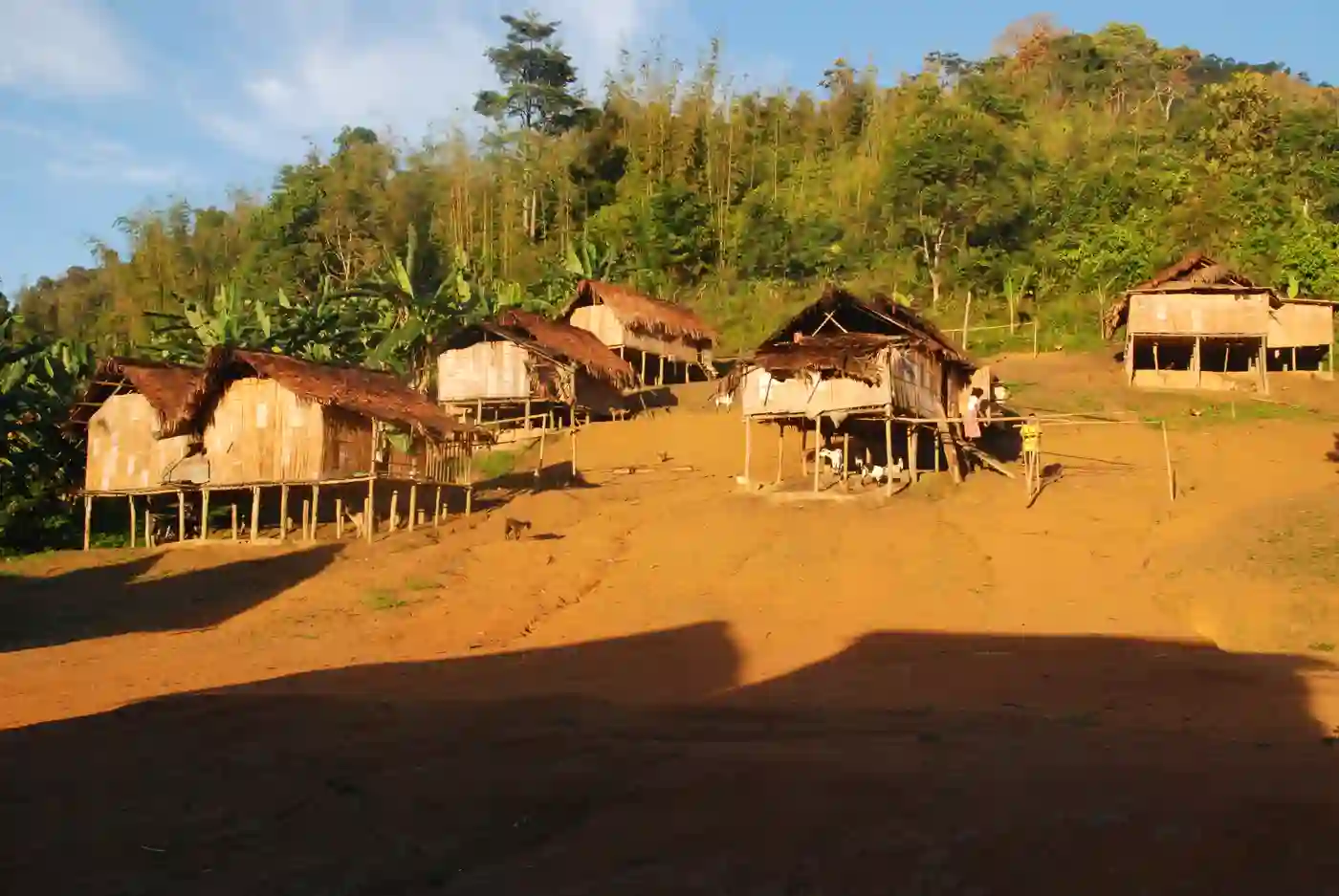
A Semai village on the hillside at the Tidol River
One upriver kin group would always know of the other groups in their region, and so when a situation arose that needed people present to discuss and sort things out, a messenger would be sent over to one group and the word would be spread to the others. In this way, the elders from all the homesteads could be called over the mountain pass to be gathered for a soul-sending, or a funeral, and after a few days they would return over the mountains and bring news to their region. If a group of bandits from the lowland had been seen near to Sen’oi areas, the word would be sent to the next group upriver, and from there to the next, so that people could prepare to flee. The elders had a mental map of all the rivers and who lived at each and no one lived in total isolation.
Then came ten years of forced migration when they were taken from their hereditary lands and moved out of the ‘war zone’ into camps, where they suffered unsustainable death rates caused by over-crowding. After this the Sen’oi from every region were desperate to return to their former homes and live in peace again. But even though the dominant rich people, from other lands, allowed them to return, they did not permit much freedom of movement and the kin groups resettled, cutting swiddens in a mile radius of the army fort. The forts became known as ‘posts’, where clinics and schools were started in the 1970s, and over the next 30 years the Sen’oi remained close by. By the 2000s, their homesteads had turned into what we would recognise as villages, with running water, clear open spaces and road access (the latter thanks to the logging companies’ concern for hardwood).
In the present day, the Sen’oi live in clusters of 10-20 homes, often near to a main river, and they access the river source valleys only for hunting trips or for collecting materials. An open and clear area is commonly found in the middle of the homes, which is used for games or socialising after work. It is often kept bare earth to prevent weeding over, but where they have grass-cutters then they can keep it green and tidy. A takraw court often occupies this space where men play a popular Asian game with a hard ball kicked or headed over a net, but it also usually becomes the defacto car park for visitors who are clueless to its real purpose, causing safety issues for small children. Not that the children are seen when the sound of cars is heard (in the remote villages) as they have already hidden themselves in the homes to peep out through the wall gaps with other occupants at the arriving foreigners.
Remote villages which still have access to the forest and its resources are treated as ‘base camps’ by the Sen’oi inhabitants, from where they launch their forages, day-trips or camping trips, into deeper forest. The Temiars even call their cluster of homes the kᵻᵻm, which comes from ‘camp’. In the lowland, however, where their homes are surrounded by commercial plantations, not far from their doorsteps, they live a life seeking out paid labour so that hey can buy food for the family which sit at home with no forest to explore. The Malay-derived term kampung is only used to identify villages to outsiders.
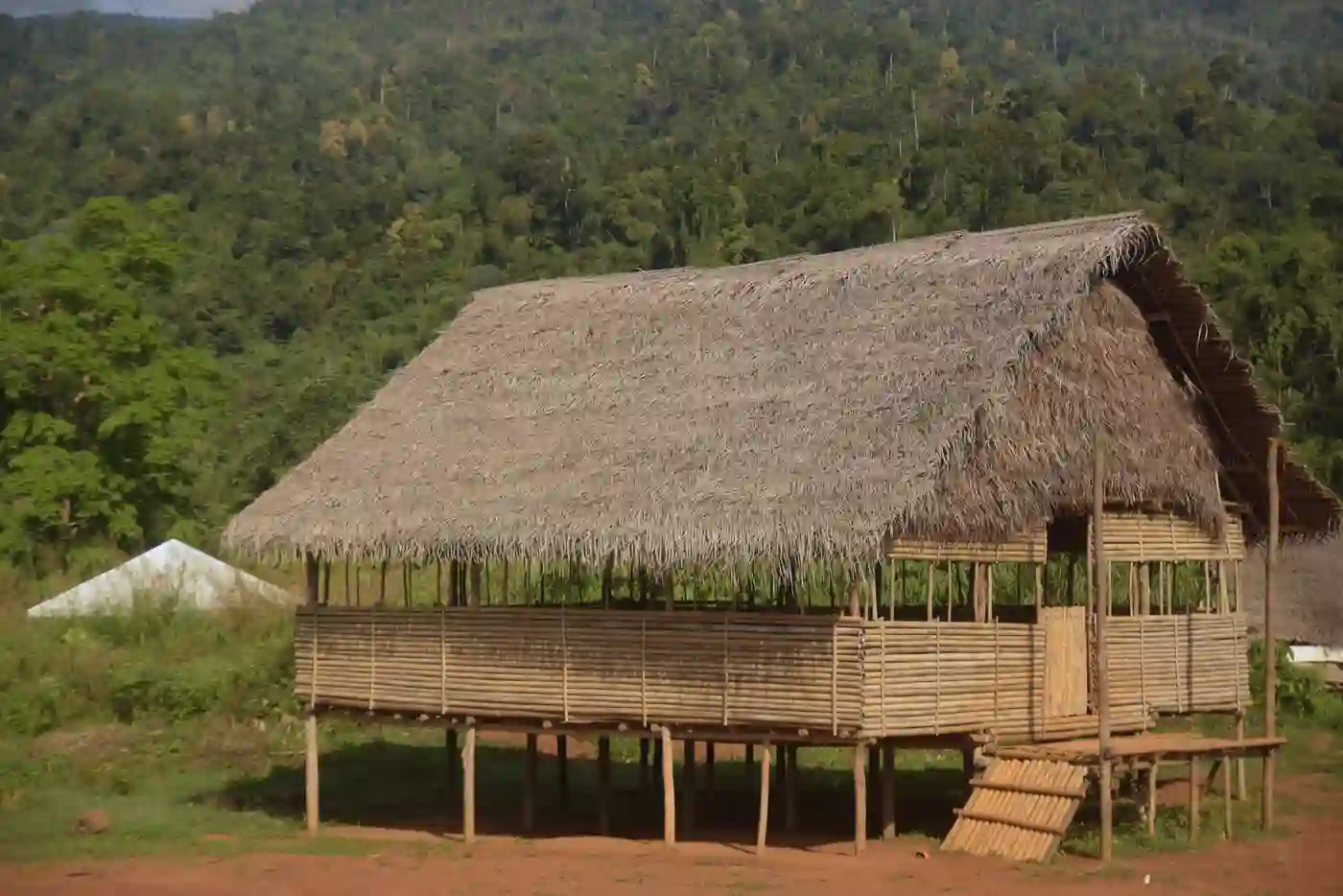
A Temiar meeting hall
Somewhere to the end of the village, and sometimes hidden from sight, is the balɛy, or traditional meeting hall, where ritual ceremonies and discussions are held. It is normally treated as a sacred assembly place and not made available to people outside the community. The hall is usually made of natural materials such as bamboo and braided palm branches, even in lowland areas where materials are difficult to source and might have to be transported to the site by motor vehicle from a mountain area. Many villages are surrounded by fruit trees, such as durian, rambutan, langsat, jack, coconut and others, and old village sites will be noticed by 50 or 60 year old trees that now tower as real forest. The land arround the villages, if not reallocated to oil palms, is often noticed for its dense bamboo growth, where swiddens have been cut in former years, and large trees are often lacking.
Each village has its own history and identity due to the ancestral background of the kin group, and although people visit other villages, they are not homogeneous with each other, meaning that people do not freely move to other places outside their own kin area. However, a young man may look for a wife from another village, especially if relatives moved from there in the past and there are still good relations. Often people from the top villages marry across the mountain on the other side. Or perhaps they marry further down the valley where relatives have gone before. But in modern times, with the advent of social messaging, people discoverer each other through the phone and can even agree to marriage before they have even met in person!
In the 1980s-1990s the government implemented a dozen relocation schemes across three states, urging village headmen to bring their villages downriver to new settlement areas, each based around a school and clinic. Thus centres such as RPS Pos Betau (Bʹtəər River) in Pahang, RPS Pos Kimaar in Perak and RPS Kuala Betis in Kelantan were formed. These turned into conglomerates of up to 20 villages in one small area, just twoo to three miles wide, and each new village only 100-200m from the next one. The Sen’oi were provided subsidy homes, which were planked in the early days, and paid dividends from the proceeds of the plantations, which had sprung up on all their now vacant lands. Labour was outsourced, however, to foreign workers, leaving the new villagers to scrounge for money to survive on or steal from the rubber pots. Some people managed to snn the leght and give up on the idea of conglomeration, making a return to former remote areas, where they could forage for themselves and plant swiddens, but these are probably only 1-2%, if that, of the whole. Many people too to the new lifestyle, where homes could last 40 years, there was good road access and shops, and even access to alcohol. You could visit one village and find the people of one social type and then the next village on would be of a different social type, dun to the fact that one was Christianised, the other Islamised, or another full of drunks playing loud music. But you would not meet anyone anti-social or violent and no one would chase you off, and every one still ate wild boar (my experience in Betau, 2008).
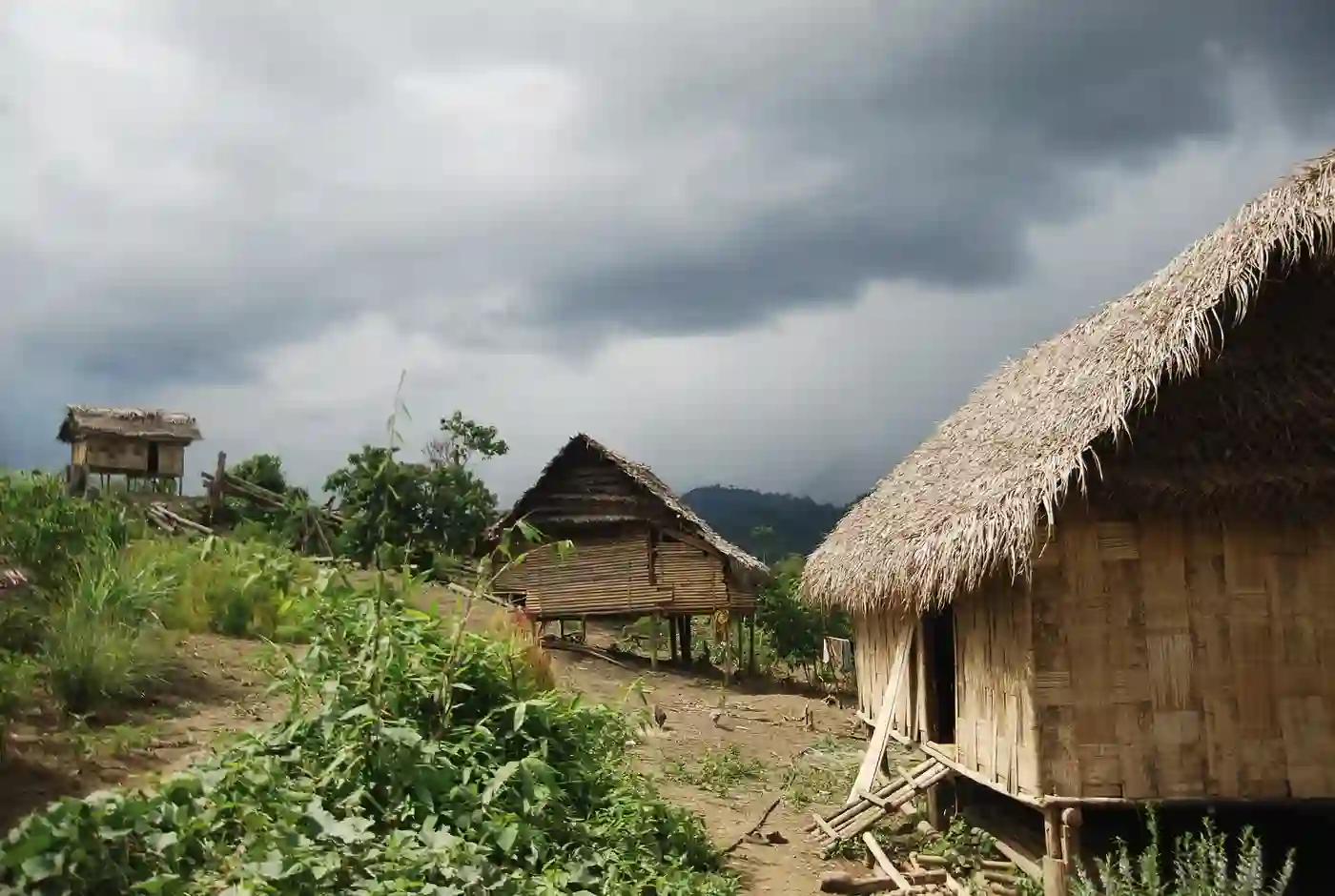
A Temiar village on a hilltop, at Tɛmagaaᵏ
Visitors to remote villages primarily include local traders, either to collect forest wares, such as furniture-making rattan, or crops, such as bananas or durians, and also teams of nurses from the nearest health centre or from Gombak hospital. The traders are useful for bringing in money as the Sen’oi normally can’t transport their own wares to town, except for a sack of chilies maybe, on a motorbike. The traders also cart in necessities such as rice, oil, soap and whatnot, even fresh chicken and fish. However, some traders are suspected of fixing their scales so that they don’t depress properly and a huge bunch of bananas might not fetch such a good price with them. Other visitors include promoters of religion and sometimes the odd NGO, distributing free food or solar lamps. Some remote villages become favorite destinations for off-road touring groups, who drive in with 20-50 cars and churn the road into mud. The villagers sometimes construct a camp ground with chalets to accommodate them, in return for food hand-outs or money. The general public do not wander off-road into Sen’oi areas, unless, like in some places accessible from town by paved road, there is a popular picnic spot at a waterfall, that doesn’t seem to fall under Sen’oi ownership.
In the old days extended families lived in a communal longhouse, and this culture of sitting together, sharing food and discussing continues today even when families live in separate homes. Each day you’ll see people paying visits to their neighbours, without any invitation needed, involving them sitting in the living space and often being served a drink and food if food was being prepared when they entered. They might even sit near the fire if they are closely related to the family and would be welcome there, as the fire is a central part of the living space. In some villages they may built a shelter with a raised floor where people sit and chat during the hottest hours of the day. this is where many plans are made, such as the day’s activities in the forest, without the need to call a general meeting. Otherwise, for important issues, such as new people moving in, a marriage, or swidden cutting, a meeting will be held in the hall, so that all can be involved.
During the day, village children play in the open area in the middle of the homes, or draw things in the sand. Little ones make houses with stick ‘walls’ and put sticks inside them to be people. Bigger children play games such as hopscotch, sometimes throwing the mud or stone over the shoulder without looking, and collect it from behind the back, on all fours. Sometimes they all play a game where they run from one end to the other end while some stand along a line and try to catch them. In another game one team have to rebuild a tower of cans while the other throw flip-flops at them. They make their own ball often from wrappings of plastic. The standard brown rubber band becomes very versatile in that it can be joined up into a long skipping rope which three or four jump over together.
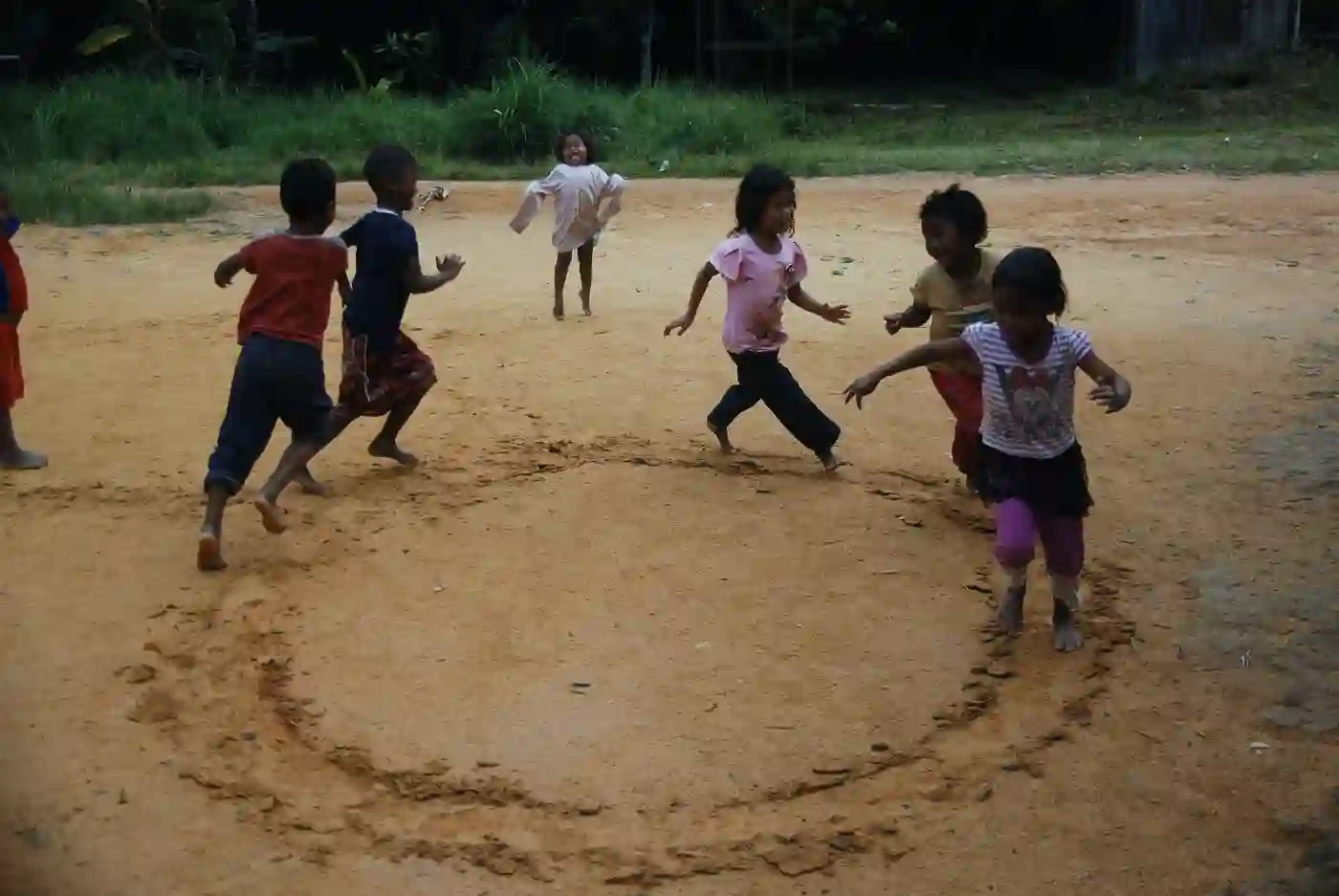
Children play a game in the open space of their village in Kelantan
Boys make wooden spinning tops and they try to hit their friend’s top off the sand while it’s spinning. They also make tops from a large acorn nut by skewering a thinned bamboo stick through it. A circle of boys will set their tops spinning on the sand and see whose spins the longest. In the durian fruit season, the boys play durian stone wars, which is something similar to conkers. except that there is a nail inside the stone. At other times the boys make pop-guns from a plant tube and a pusher stick. The “ammo” is wet a small berry, and it works on the principle that one piece inserted into the tube and pushed along will create pressure against the one inserted before, and will “pop” the ammo piece out. Boys often make their own toy cars from soft wood, making use of all kind of scrap items to make wheels, even old flip-flops. Some can make bulldozers, trucks, excavators, and so on, while most younger ones fix two wheels the the end of a pole and drive them about. Girls cut sticks of a zingiber plant and smash the end to make fibers which can be brushed like hair, to make their dollies. They also construct their own play houses with banana leaf roofs in which they sit and cook leaves in old cans.
Women are often seen coming home with baskets loaded full of forest foods, such as manioc roots, banana flowers, bamboo shoot cones or sweet corn. But most often the basket is filled with lengths of split bamboo for the fire with some fruits on top of that. Men might come back from the forest with an extraordinarily long bamboo pole balanced on the shoulder, or a heavy firewood log, which are stood lent against the house. Each village has a nearby area at the river for washing and bathing, and it is a favorite play area for children, who become good swimmers at an early age. In the mountains, the main river can surge massively after heavy rain, and this is when it’s most dangerous (usually at night), with its power moving great boulders along, and logs, driftwood and bamboo at great speed.
Education for Sen’oi children is almost nil, with schools provided but which teach them practically nothing while placing the blame on them, as if they were not willing to learn. But note that children are separated from the homes for months at a time in some situations and from their play environment, with forest and rivers, making them feel permanently home-sick. The teachers generally don’t try very hard and these days all the children have their own phones which are in constant use. What knowledge young people gain they generally have to learn from their elders and from the way of life that relates to their natural environment and the forest around them. But of life affected by the outside economy, they are pretty well starved of knowledge.
Most Sen’oi know the Malay language because they are schooled in Malay, and you can get by with this. But really the fun begins when you speak with them in Semai or Temiar, depending on their tribe, because that is the heart of them. Malay is just an outsider’s language to them. There are very few who know any English and if they do it’s because they found out themselves, or were very bright in school. The Sen’oi will welcome visitors, but because of continual mistreatment over the years, from outsiders who have such different ideals, it is hard for them to trust everyone. The Sen’oi generally have no contact with tourists, except for selected villages in the Cameron Highlands. which are on the tour maps, and offer culture shows, or those who sell honey or petaiat the road-side. Otherwise, the Sen’oi are well off the tourist map and the Department of Tourism is probably happy to keep them off it. Villagers might have great ideas for promoting tourism in the areas of great natural beauty near their villages, still unknown to the outside world. But it is normally the Malays who bring the tourists, into these places, pushing aside the natives.
Where villages have landed themselves in alcoholism, often due to the loss of hereditary lands and culture, young men can get drunk by mid-day after drinking dirt-cheap liquor of 43%, called Thai Song. They spend what little they earn each day on the stuff, so you can imagine how this affects family life among them. In some areas substance abuse has become an issue and gangs violently seize money from passers-by to pay for more highs. Remote villages are generally clean of alcohol, but when men travel to the shops they might get a bottle and com home falling in the roadside bushes.
Up until 2015, entertainment might have been provided by just one house in the village, with a TV and DVD-player, powesed by a petrol generator, and fed with Hindustan movies or Dendut pop artists. Only a few locations managed to fund a satellite channel box. Nowadays, since 2022, many remote villages have receive satellite internet links which has allowed the downloading of all kinds of good and bad content to be viewed on smart phones, or linked to the TV screen.
Communications took a massive leap forward with the introduction of Wifi and messaging apps, replacing the usage of SMS on 9-button ‘cowboy’ phones. Now long voice messages are recorded and sent with ease and people from multiple communities join specific groups to chat and share news, bridging the geographic distances and bringing them closer together. The news of a death can be spread literally the same day, instead of taking days to reach upriver areas. Most Sen’oi still have little idea what the internet is and even of the existence of web sites, and are limited to social media platforms, probably never searching for anything in a web browser.
Previous : Story Intro
Next : Sen’oi homes