

The Sen’oi make their homes from the materials that are readily available to them and usable with the basic tools and joining techniques that they possess. Wood, bamboo, rattan and jungle palms are the basic materials of any home. Hardwood piles are set in the ground and extend up to the roof, supporting the whole house above ground, and can last for generations as successive homes reuse them. Light-weight, straight wooden poles are laid for the floor, wall bars and the roof runners, which rest on a centre pole. Boards of flattened out bamboo make a smooth floor surface and sturdy walls, the first being a simple laying out and fitting together on the poles, or on a layer of split jungle palms. Walls are crafted with more care, the bamboo boards are woven in and out, to make a solid wall area, or stood vertically and clamped with split rattan. With even more care taken, a wall can be made of thinned-down palm skins woven into ‘diamond’ patterns. Most Temiar homes are made with bamboo poles (not flattened out) stacked upwards and tied with rattan cord, between a wall post and a clamping pole. They prefer this way for its speed of assembly as well as the strength and security the wall provides. The walls let in just enough light from the bright sunshine through the gaps, only needing very small cut-outs for peeping out of.
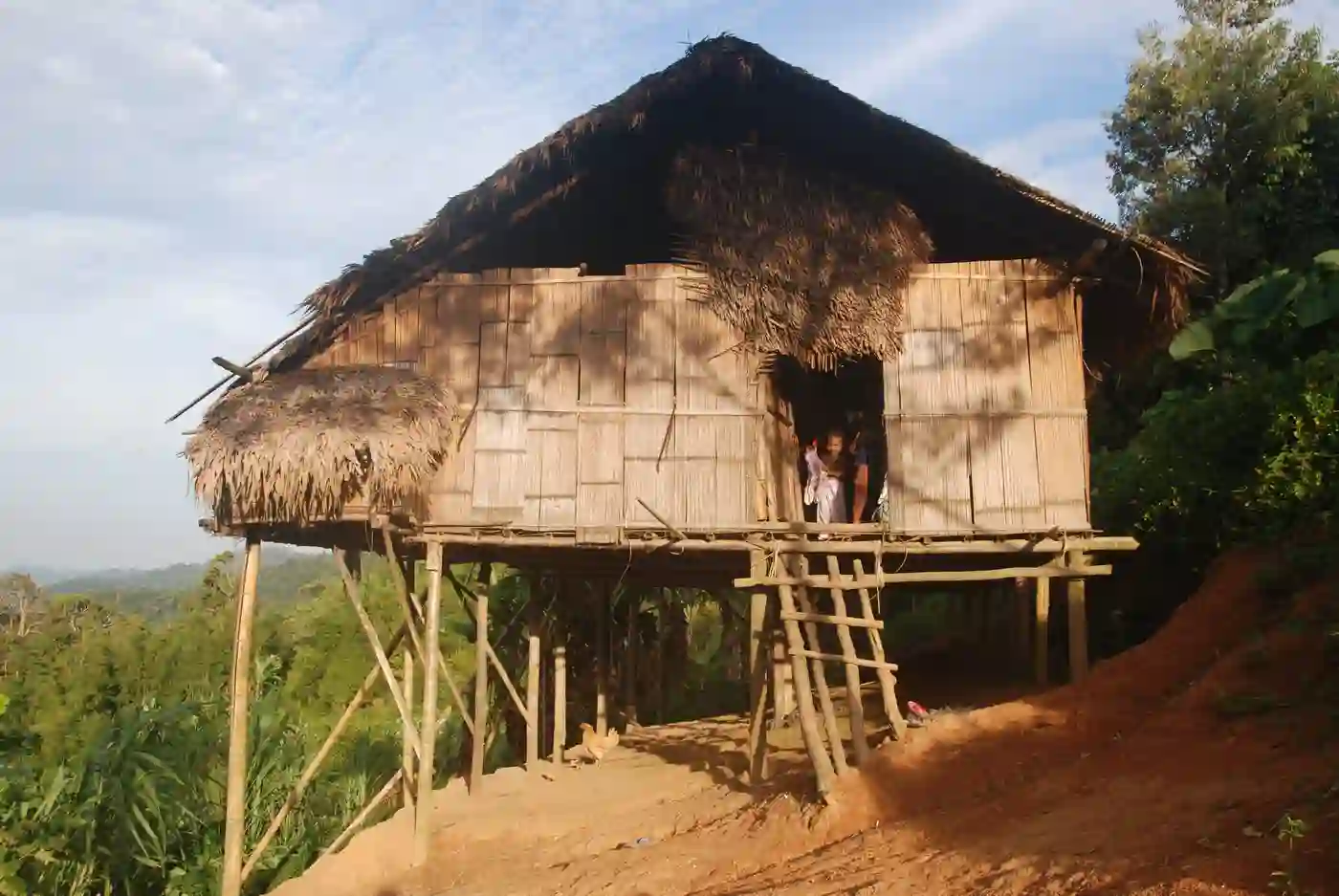
A Semai home built on piles
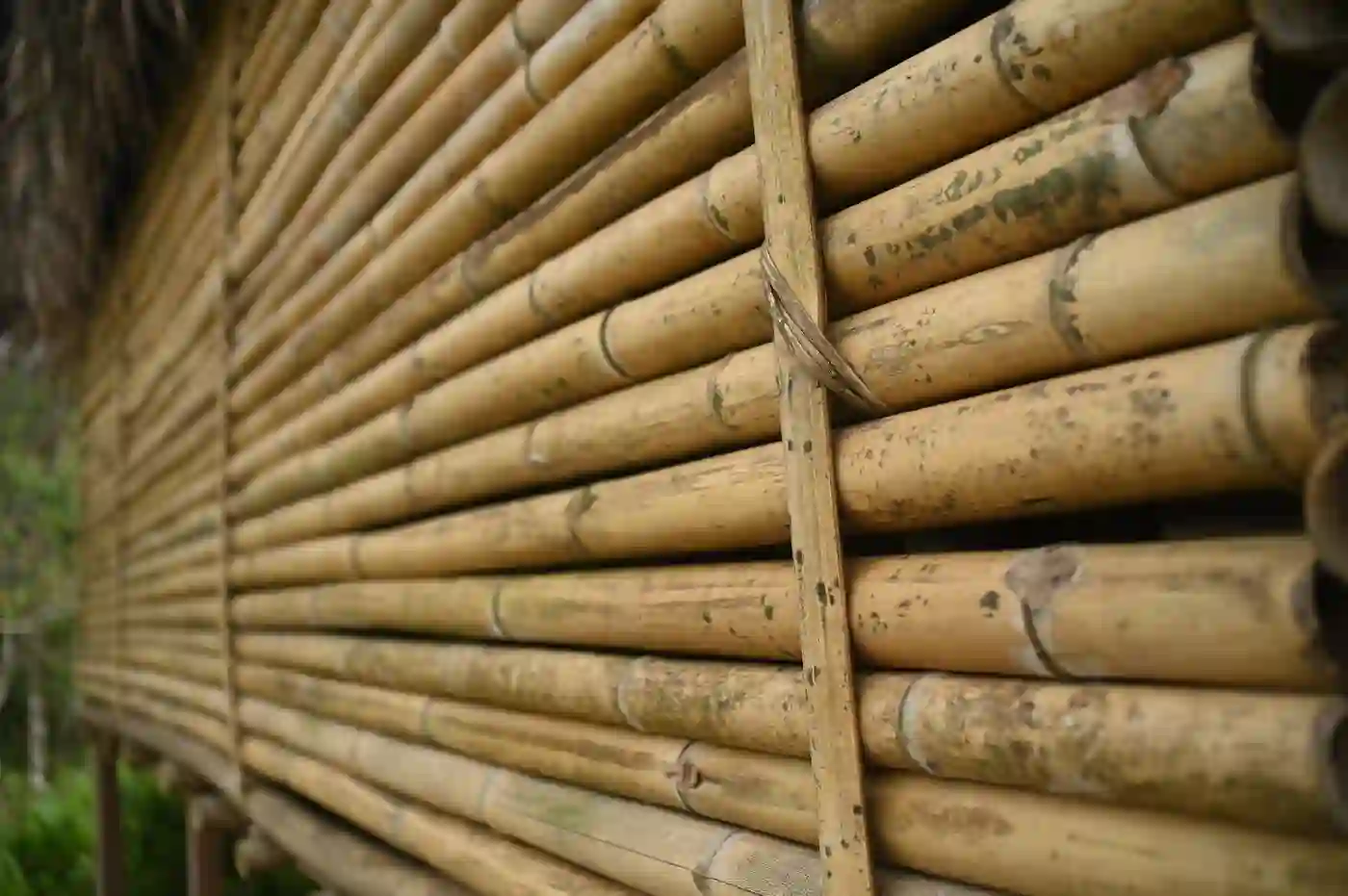
Stacked bamboo poles of a Temiar house
The doorway is often a few feet from the ground and is reached by stepping up to a lower level made of bamboo poles (where dogs and goats find a place to spend the night), or a steep ladder, or an angled pole with one end on the ground and one end at the doorway. Raising the house above ground means that animals and dangerous creatures such as centipedes and snakes, will stay at ground level and not wander into the living room. Some homes are made at ground level as well, if so desired. Often a Sen’oi home has only one room with the fireplace in the middle, on the floor, and the family sleeps on floor mats which are all laid out at night time and put away in the morning. But there are other homes with more ingenuity, with adjoining bedrooms, walled off, or a house extension for a sleeping place, with just a ‘window’ in the wall of the main room through which a person crawls to get into it. I n days gone past, the Sen’oi built long-houses that would accommodate half a dozen families of the same kin group, with fire mounds down the centre of the house, but since around 2005, families have built smaller, individual homes.
Roofing is made from two kinds of jungle palm, depending on what is available in the village area—a heavily leafed palm, which needs a steep roof construction to shed off rain water, or a more sparsely leafed palm found in higher altitude forest, which can be roofed less steeply. Villagers building new homes, for example, a newly married couple, or someone who needs to replace the roofing, will spend a few days in the forest selecting and cutting palms. The branches are stacked in piles of ten and the leaves are wrapped into a long bundle. the bundles are then carried on the shoulder down to the village. The bundles are opened and the leaves are braided to make flat sheets. The narrow-leaved palms are sewn together along a rattan cord into a large mat, which is rolled up and then hoisted to the top of the roof, tied on and unrolled into place. Perhaps fifty branches may make up one such mat and a good-sized home might need six on each side of the roof. The densely-leaved palms are tied in pairs to poles on the roof, each pair overlapping the pair beneath, until the top is reached. It can take a months to build a new house, with many days needed for sourcing the best kind of bamboo, the best roof palms and the straightest poles.
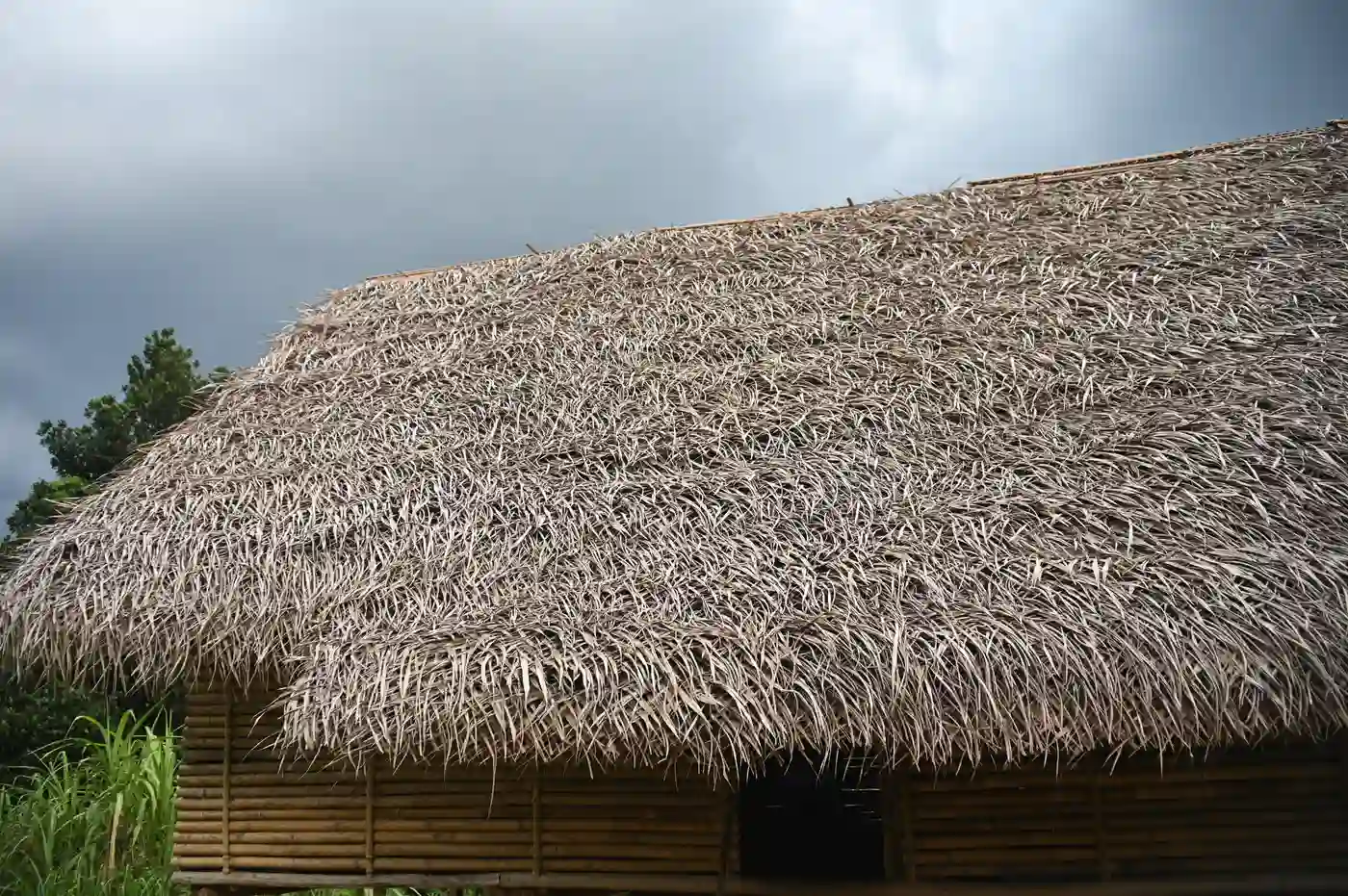
The palm-leaf roof of a Temiar house
In some areas the materials are now difficult to source, with the forest taking a knock from the diesel engine, and villagers strive to obtain steel roofing. Many homes reuse the same old corrugated roofing they bought twenty years earlier, which has since rusted and torn open. In 2025-2026, steel roofing was donated to hundreds of families, enabling them to build homes that will last much longer, as palm leaf roofing might only last three years. Likewise, in the old days rattan cords held the whole house together, but now with the scarcity of the vines, iron nails take their place. The vines are still essential fro tying on wall poles and roof palms and tying skills are not lost either, with boys being able to single-handedly build a water-proof house before the age of twenty. Women can tie with rattan too, but their task, except for braiding palm leaves, is most often to prepare meals for the house builders.
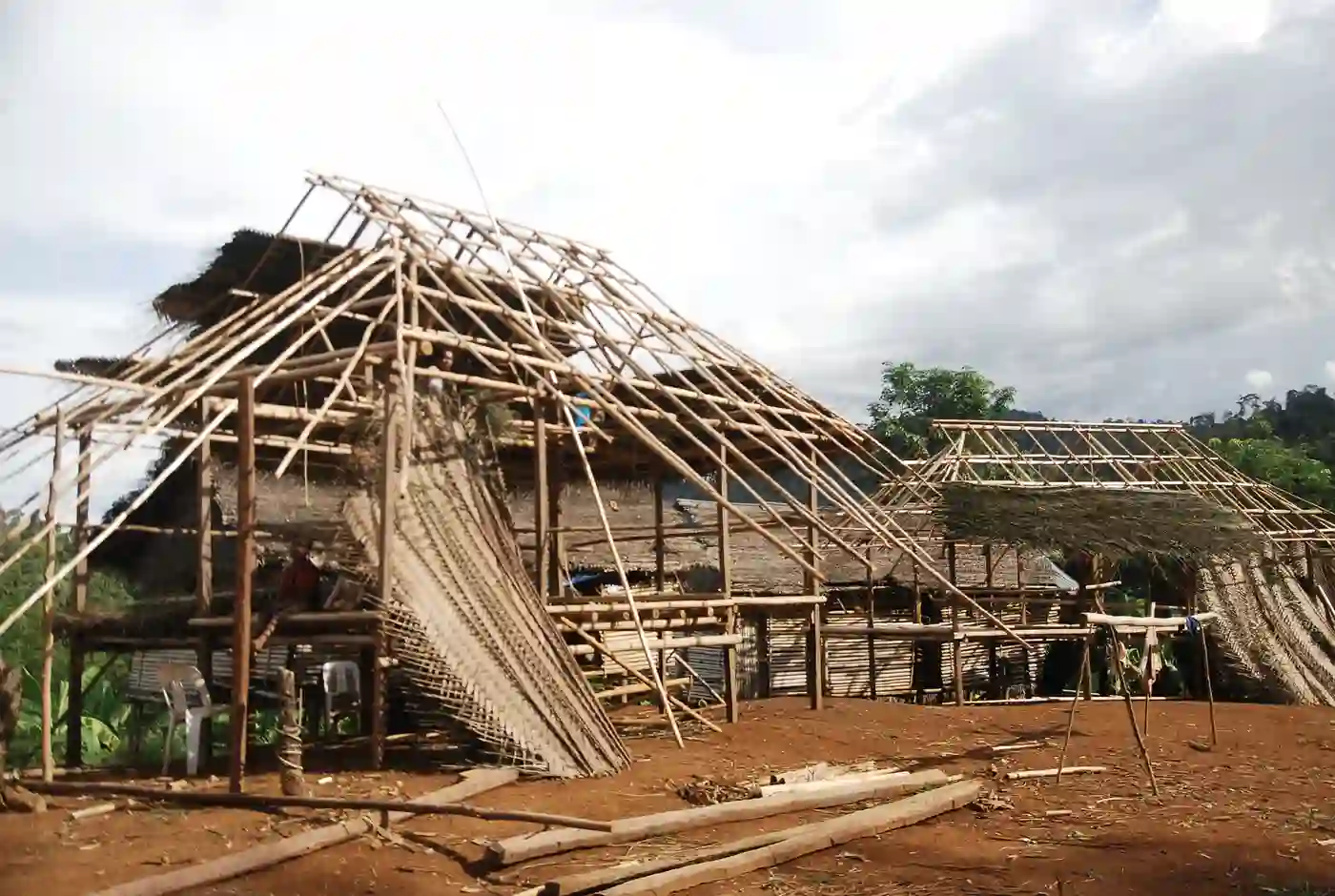
Temiar homes under construction
With the Sen’oi there is a mix of lifestyle—those who have learned to clean their homes and those who live as they did in the old days, when they were surrounded by jungle, had no shoes, and walked dirt into the house every day. Usually it’s easy to keep a home with a bamboo floor clean as all the dust falls through the gaps. Bamboo is itself a remarkable material with so many uses, as well as long durability and the ability to be clean even after food or mud or even blood is spilled on it. The Sen’oi make a hand broom from hornbill feathers tied together, or, more ingeniously, stuffed into an old metal torch-light body! However, while this is so about their village homes, a visit to a jungle hut might repel some people, when seeing the amount of ash or soil from manioc roots or muddied feet all over the floor, and a pile of manioc skins, animal bones, corn cobs, or durian skins at one side (including all kinds of shoes, tubs, manioc baskets scattered around, with their dogs and cats as well). Some village homes are not too clean either and often you have to forget your own preferences and accept their idea of life, as you sit near the fire, on the bamboo floor that needs replacing, broken and stained, the ash spilled out from the fire mound, and food scraps and cooking water tipped out and dropped under the floor, and sometimes their feet caked with dirt and ash dried out by the fire.
One thing you will always notice in the Sen’oi home, apart from the fire mound and the long fire logs, and the pile of pots and plates all balanced in a plastic wash tub, is the clothes store. Piles and piles of neatly folded clothes, of all kinds, flowery Indonesian sarongs, T-shirts, trousers, kids clothing, of all colours, all lined up against the wall or on a built-in shelf. And the Sen’oi have only been with clothes for the last sixty years or so. Apart from the clothes store, the cooking pots and wash tubs and machetes, and some small carry sacks hanging from pegs on the wall, a family won’t have much in the way of personal belongings—except for a TV perhaps, sometimes with an amplifier and three-foot high speaker! You’ll not see a picture hanging up and there’s never a single piece of furniture—not a table or chair, or anything comfortable to sit on, as they all sit on the floor. When eating, talking, discussing, singing, or watching TV, they’re on the floor. Men like to stretch out and lie on the floor if they’ve just come back from a long walk. They don’t have cupboards and the only shelves they have are home-made.
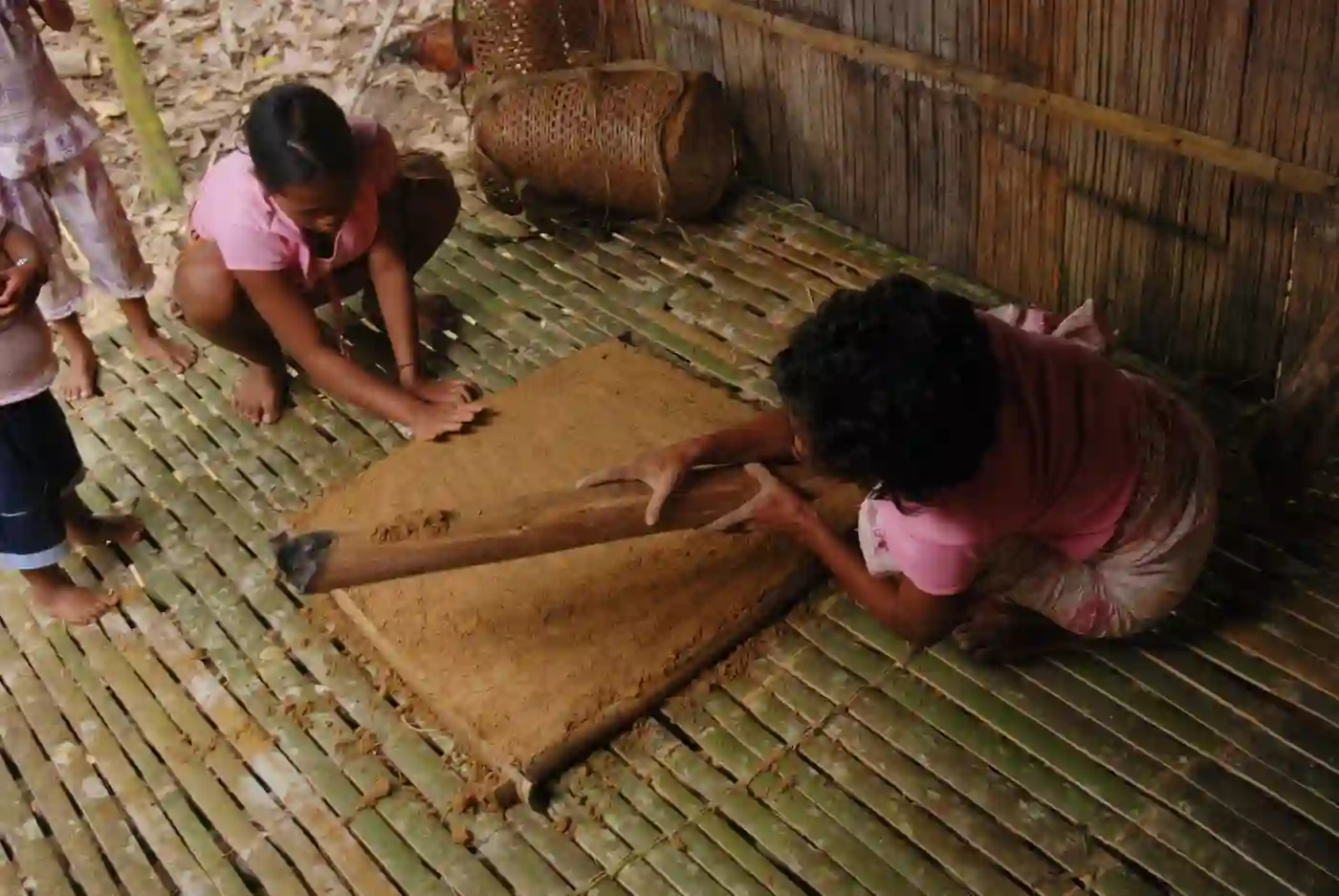
Two Semai women pound earth on a new fire mound
The Sen’oi home will have its fire mound, called a waal, and the part of the house dedicated to the fire place is the fire-house, or dəəŋ waal. Here the flooring is of thick bamboo with gaps between (for pouring water and sweeping food remains under) and then the fire mound sits on a square board of bamboo, and is made of earth pounded inside a ring of bamboo, or a square of inter-locking bamboo parts. The earth soon dries out and it allows a raging fire to sit on top without burning through to the floor. Long and heavy fire logs are carried from the forest and laid with one end on the mound, and the other end going outwards, usually with up to four logs. As they burn they are pushed toward te centre. The fire is lit at the centre with dried bamboo, or karooᵏ, that has been collected from dead bamboo in the forest, cut short and split apart. Properly dried bamboo burns very well and it’s used every time they need to cook, boil the kettle (rested on an iron ring with three legs), or just to ‘guard’ the night if they are awake, or to keep warm in the cool hours. Some people light the fire when it thunders loudly, to keep the thunder away—but they don’t have a light to turn on so they light the fire. Typically in the morning, they light up the fire to boil the kettle, while a woman peals manioc and scrapes it, and when the log ends are glowing hot, the roots are baked leaning against them. The fire-house is often the social place of the house, where villagers come in and sit around the fire, chat and laugh, warm their feet on the mound, and share some sweet tea and meat.
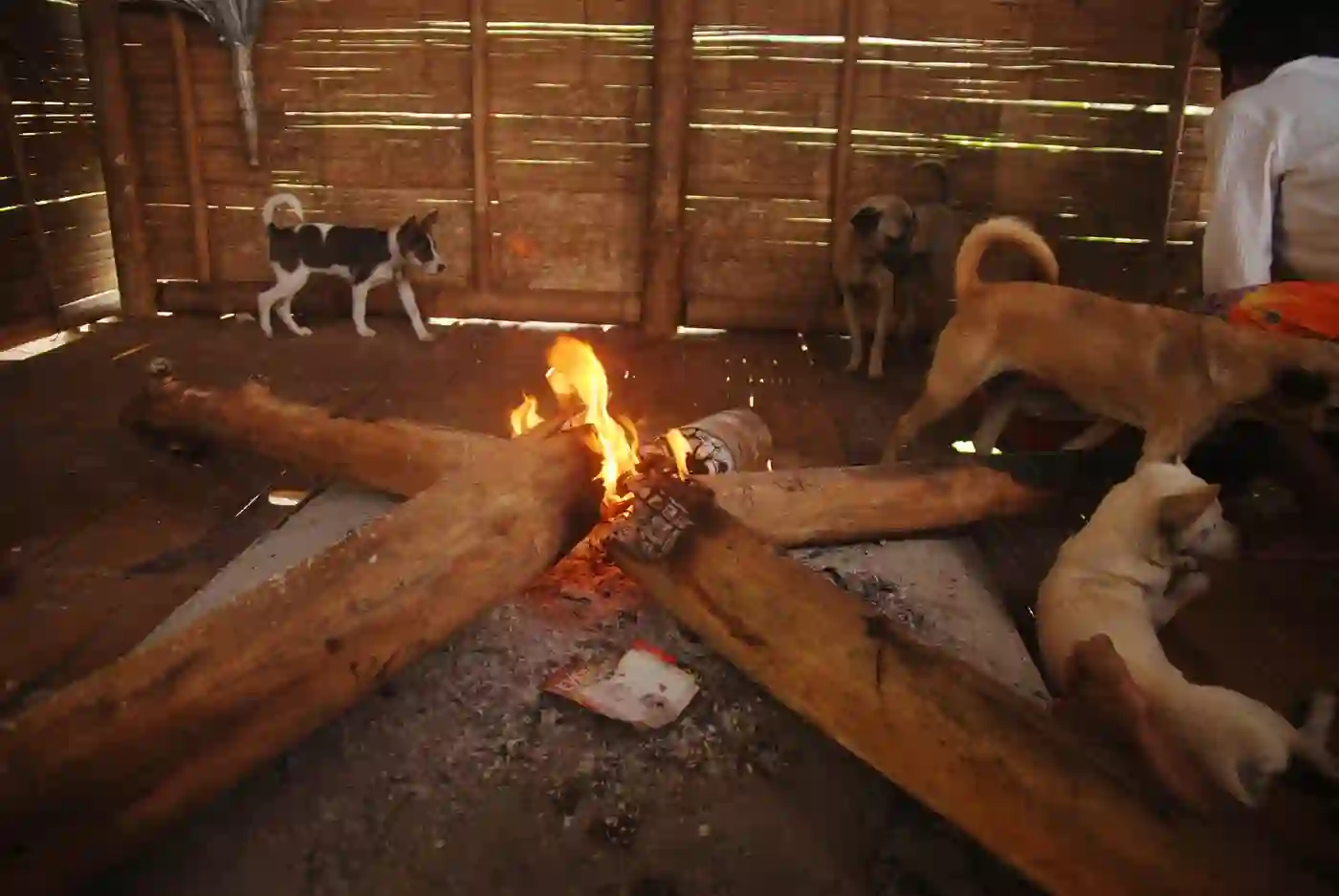
The fire mound, used for daily cooking
Above the mound is the hanging rack, called a baraᵏ, where meat and left over food is kept above the fire and away from intruding cats. The rack can be made of poles or wire mesh and is typically longer than the mound, and is covered with sooty dust, some hanging like old webs. On the rack hangs their poison dart box, and often bunches of corn in skins, being kept for seed. Meat laid on the rack becomes smoked and preserved—whether it be rat, tree shrew, deer, or wild boar, even river fish. Many times I’ve arrived at a Sen’oi home and they tell me of the great wild boar they caught three days ago, and how they ate so much of it. Then to my surprise they bring down some black-red hardened lumps from the rack and put it into the fire or slice it up for the pot, to cook with manioc. It’s usually always good, unless it’s already begun to rot! Sometimes a trapper finds an animal snared and it’s been dead for a day, or two days, and begun to reek. Waste not is their motto, because food is hard for them to come by, and they don’t deem it to be harmful for them. So I’ve often had cheesed-off boar meat, which is not all unpleasant, but good actually. On occasion I’ve been given meat that really reeks of death, which was harder to swallow! One time, they brought back a leg of boar to the house that looked like a rotting corpse and they had to chop it up to boil it. The stench was strong. Quite often, it’s only the stories I hear, of a great hunt they had, but sometimes I arrive and they smile broadly and make the ‘silly wild boar’ sign with the hand, like a hand puppet sniffing along, and tell me there’s meat in the village! Seeds are hung from the rack as well, including peanuts and sheaves of millet. The woven palm leaf roof always looks intricate and uniform on the inside and a mature roof will be quite blackened from years of daily fires.
Water is plentiful in the mountain villages. With government help, pipes have been laid from a good water source higher up and so a village often has continual running, clear and free water which is divided by smaller pipes to different parts of the village. Only after heavy rain will the water silt up for a while and perhaps run dry until the pipe is opened somewhere to let the silt out. The rivers are also beautiful and clear in the valleys and most villagers bathe there if it’s not a long way down a hill. There’s no direct water supply to homes in most cases and so water is collected daily, in plastic bottles of all sizes and kettles, and a good store of water bottles is kept in the house, in case of the pipe silting up. The river can also rise very quickly in heavy rain and it becomes unsafe for bathing—wood and bamboo coming down and a huge force of water swirling over the rocks.
Before the introduction of solar-powered lamps (2020) homes were lit by simple oil lamps, made from tin cans, burning cooking oil, or diesel, as well as the fire place. Some villages had solar batteries installed per household (2006?) which allowed them to power TVs for a few hours each day, and lights too. Some have a petrol generator so they can power up the home entertainment system, giving one house and the others connected (by home-made wiring) to be lit up for an hour or two. But they can’t just flick on a switch in the middle of the night when they need light. Only in downriver areas does the electric grid reach villages.
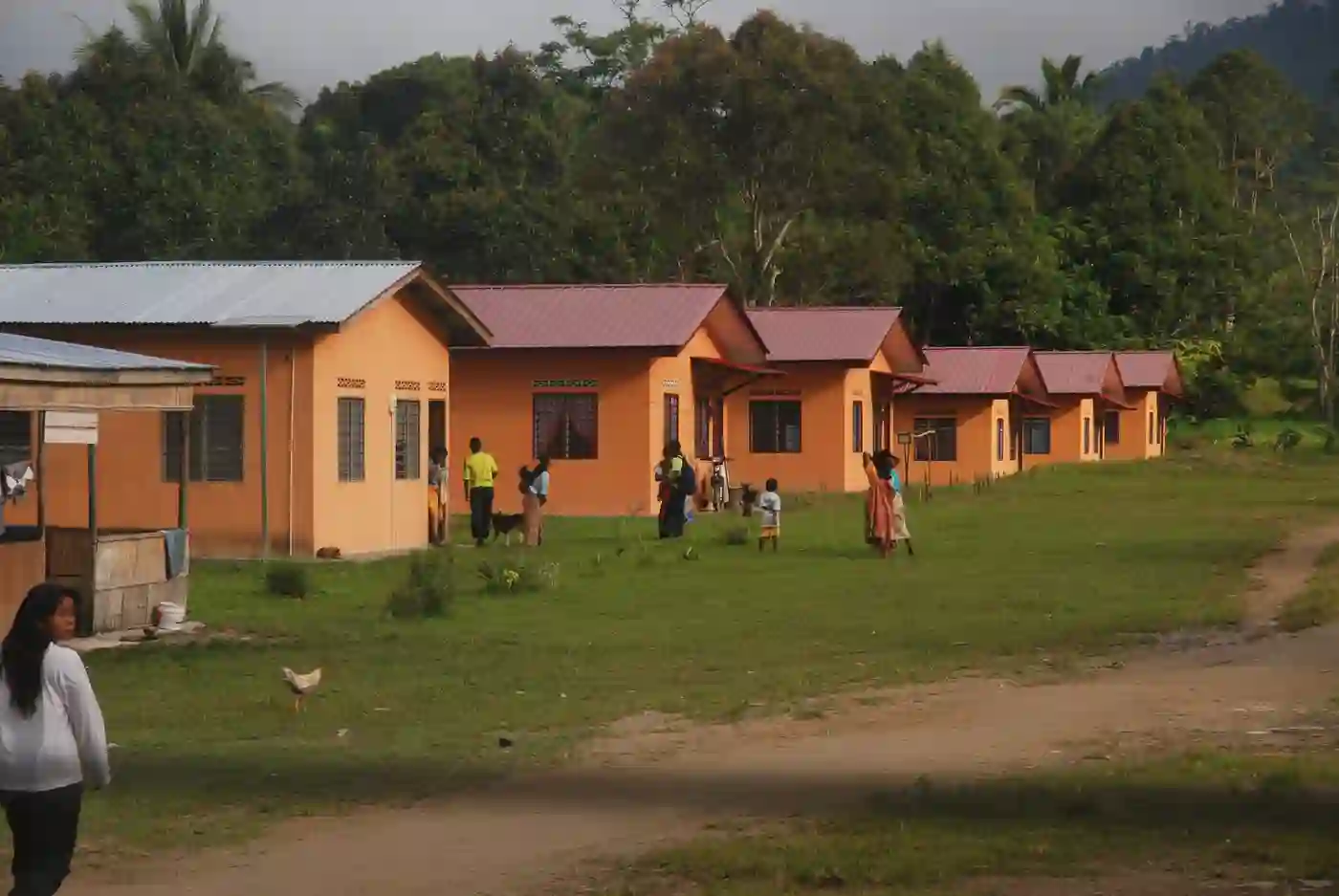
Subsidy homes in a Semai village, in Perak
Many villages have had subsidy housing built since around 2008, but these are found mostly in lowland areas, with upriver regions only seeing selected places chosen for construction. The homes are identical cement-brick with steel roofing, of about 25ft long with two or three small rooms, a bathroom and kitchen sink. The homes are welcomed by those who struggle to collect building materials but they also have some failings, as depending on the contractor, if they can work without being seen and take shortcuts, the homes might not last long beforn breaking. Some homes have cement spread over a layer of sand fo a floor with no underlying concrete, and the floors and walls have visible cracks. The Sen’oi are not able to work with cement and fix their homes and neither are they able to demolish and rebuild in case of moving location.
In the same year of 2008, a Chinese church organisation (GTTP) sponsored materials for around fives Semai villages in Pahang to build brick homes with red fiber board roofing (see the Sen’oi People’s Gallery for images). The homes were designed only with three walls a wooden door and slat windows and the recipients were expected to use their own ingenuity to either close up the open end of the square-shaped, one-room building, or to extend onto it. Thus there were many different styles of bamboo extensions, which became the sleeping and cooking areas, while the brick house with concreted floor often became the play room for children. If anyone ever questioned why they were given only three walls, the reply was sharp and they were told not to ask for too much.
Previous : Sen’oi villages
Next :